
 EN
EN
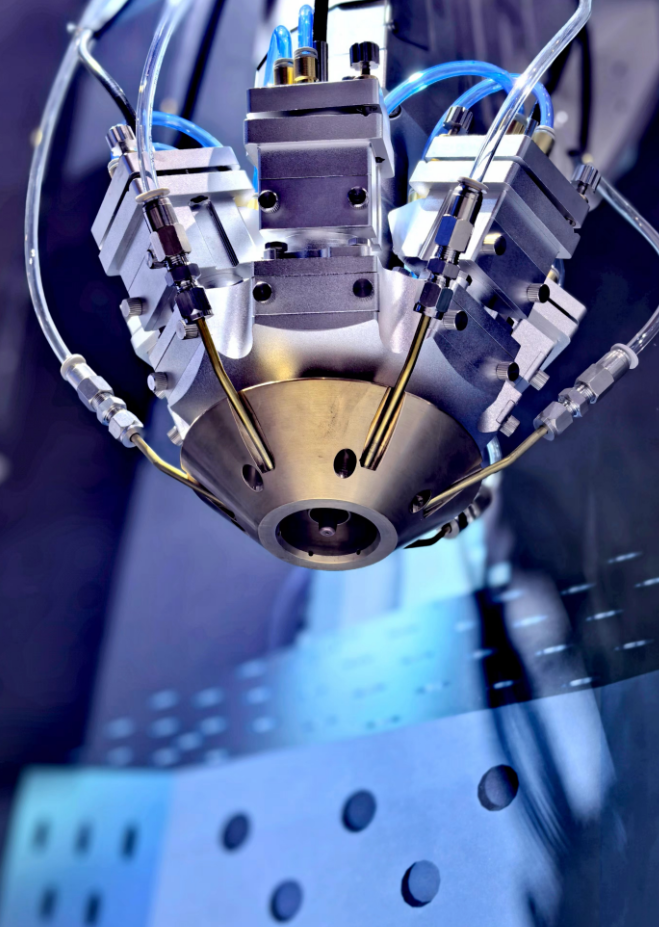
Precise Microstructure Control And Thermal Dynamics In Directed Energy Deposition
The thermal history of directed energy deposition is the primary driver of its distinctive microstructure. As a high energy beam melts feedstock, the molten pool experiences extreme thermal gradients and rapid solidification rates. Heat flows predominantly through the previously deposited layer, promoting directional solidification and epitaxial grain growth from the partially remelted substrate. This yields highly anisotropic, columnar grains that extend across multiple layers with strong crystallographic texture aligned to the build direction. By tuning laser power, travel speed, and spot size, engineers directly control cooling rate and mushy zone dimensions, thereby adjusting grain width and epitaxial fidelity. Slower travel speeds broaden columnar grains, while higher power steepens thermal gradients, reinforcing directional growth. This precise thermal leverage makes the technology uniquely suited for engineering location specific grain architectures, such as fine grained heat affected zones or coarse creep resistant columns, in critical aerospace components.
Beyond thermal parameters, advanced systems enable deliberate grain boundary design through programmable scan strategies and beam modulation. Raster patterns, including unidirectional, alternating, or specific angular rotations per layer, redirect heat flow, disrupting long columnar continuity and introducing low angle boundaries. Island scanning subdivides the build area into smaller sections, reducing thermal accumulation and local temperature gradients to promote equiaxed nucleation. Beam modulation techniques, like pulsed laser operation or dynamic refocusing, induce melt pool turbulence and periodic remelting, acting as in situ grain refiners. Studies show pulsed laser processing can reduce average grain size significantly versus continuous wave operation, owing to repeated nucleation events. These engineered boundaries impede dislocation motion, boosting yield strength and intergranular corrosion resistance. Critically, the process allows seamless transitions from fully columnar to refined equiaxed structures within a single component, enabling property gradients unattainable via casting, forging, or welding.
Unrivaled Material Versatility For Reactive And Refractory Metal Processing
Directed energy deposition excels at processing reactive and refractory alloys, including titanium grades, Inconel superalloys, niobium, and molybdenum, thanks to robust inert chamber integration. A tightly controlled argon or helium atmosphere prevents oxidation and interstitial contamination during melting, which is essential for titanium alloys prone to oxygen and nitrogen embrittlement, and refractory metals that readily absorb gases at elevated temperatures. This environment ensures full density and metallurgical integrity in near net shape parts built from wire or powder. Components retain fatigue critical microstructures, achieve the hot strength required for turbine hardware, and avoid porosity and brittle phase formation. Unlike localized shielding, full enclosure inert systems deliver consistent gas purity and thermal stability, eliminating tooling costs and material waste while preserving alloy specific performance.
The technology overcomes the fundamental limitation of conventional dissimilar joining by enabling smooth, functionally graded composition transitions that prevent brittle intermetallic phase formation. Through real time switching between powder or wire feedstocks, the process builds continuous compositional gradients rather than sharp interfaces. For example, transitioning gradually from stainless steel to nickel superalloys suppresses phase nucleation and eliminates stress concentrating boundaries. Precise thermal control further tailors solidification behavior layer by layer, inhibiting segregation and brittle phase precipitation. The result is a monolithic part with no mechanical discontinuity at the bond line, resisting delamination and cracking under thermal cycling. Such gradient structures are impossible with traditional welding, brazing, or casting, making this manufacturing method indispensable for multi material aerospace components requiring specialized surface properties over a high strength core.
Platform For Next Generation Alloy Innovation And Functional Surface Engineering
Direct energy deposition provides a unique manufacturing environment where new alloys can be designed, synthesized, and validated in a single build, bypassing the lengthy iteration cycles of traditional casting and forging. Its ability to blend feedstocks in situ enables voxel level property control, unlocking performance beyond static alloys. Systems with multi feed capabilities support real time blending to fabricate high entropy alloys and continuous compositional gradients. Rapid solidification inherent to the process suppresses segregation and cracking common in cast high entropy alloys, while refining grain structure to enhance strength and ductility. For instance, specialized compositional gradients achieve biocompatibility through wear resistant surface layers that transition smoothly to bone mimetic elastic moduli, unachievable with bulk processing. Researchers have leveraged this capability to screen hundreds of alloy compositions quickly, accelerating the discovery of materials optimized for hardness, thermal stability, and corrosion resistance.
Beyond bulk alloy synthesis, specialized cladding delivers functional surfaces with metallurgical bonding far superior to thermal spray or weld overlays. A single automated sequence can deposit a hard carbide layer on a steel shaft for wear resistance, followed by a nickel based overlay for corrosion protection, and capped with a ceramic rich thermal barrier. Each layer bonds metallurgically rather than mechanically, enabling precise, stress matched property gradients aligned to local service demands. This approach extends component life in aggressive environments, reduces maintenance downtime, and minimizes material waste without sacrificing structural integrity.
Frequently Asked Questions
-
What is directed energy deposition? Directed energy deposition is an advanced additive manufacturing process that uses a high energy beam to melt feedstock materials, enabling layer by layer construction of complex parts.
-
How does the process control grain microstructure? It achieves precise microstructure control by adjusting thermal parameters such as laser power, travel speed, and beam modulation to influence cooling rates and solidification patterns.
-
What materials can be processed using this technology? The technology can process a wide range of materials, including reactive alloys like titanium, refractory metals such as niobium or molybdenum, and dissimilar metals to create gradient structures.
-
How does the process enable alloy innovation? It facilitates in process alloy design by blending feedstocks and controlling composition in real time, allowing for the rapid prototyping of high entropy and compositionally graded alloys.
-
What are the advantages of additive cladding? Additive cladding creates functional surface layers with superior metallurgical bonding, enhancing wear, corrosion, and thermal resistance without compromising the structural integrity of the base material.