
 EN
EN
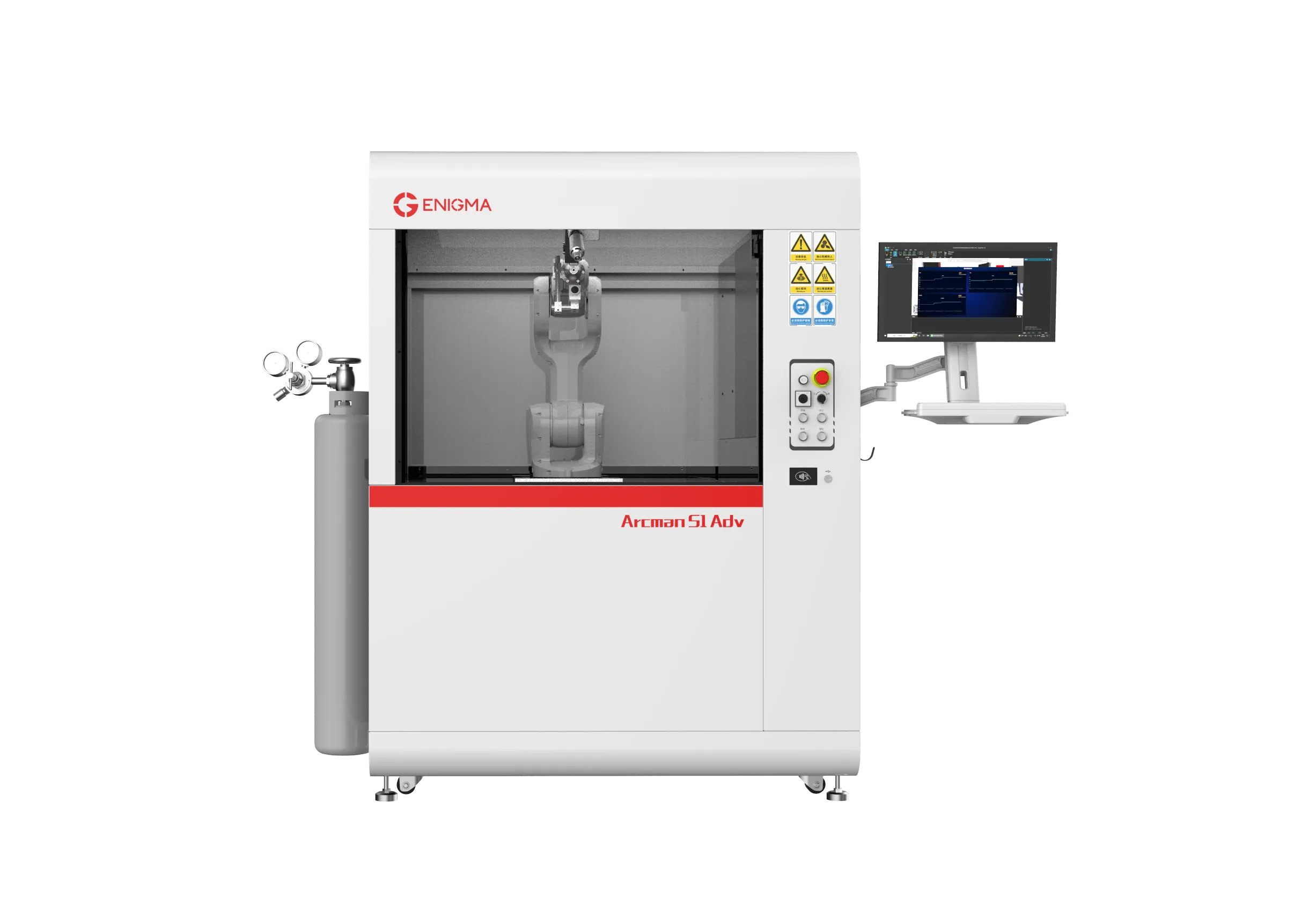
Precision Motion and Power Systems in WAAM Equipment
Robotic Arms with Sub-Millimeter Path Accuracy and Multi-Axis Synchronization
At the core of advanced WAAM equipment lies the robotic arm, engineered to achieve sub-millimeter path accuracy—critical for consistent wall geometry and mechanical integrity across deposited parts. Multi-axis synchronization (typically 6–9 axes) enables precise torch orientation control relative to complex, non-planar build surfaces. This coordination is essential not only for dimensional fidelity but also for producing near-net-shape components that minimize post-processing. High-end platforms integrate linear guides and precision ball screws to sustain this accuracy over extended builds, significantly reducing thermal drift and recalibration frequency.
High-Power Welding Sources and Adaptive Wire Feeders for Stable, High-Deposition WAAM
Commercially viable WAAM requires high deposition rates—commonly exceeding 2 kg/hour—and stable arc performance across wide current ranges (0.02–2000 A). Leading power sources from Fronius, Lincoln Electric, and Cloos deliver the required stability and responsiveness. These are tightly coupled with adaptive wire feeders that implement closed-loop control of feed speed, dynamically compensating for thermal fluctuations to maintain melt pool consistency and layer uniformity. This integration directly supports repeatable, high-fidelity deposition—enabling WAAM’s transition from prototyping to certified production environments.
Thermal Management and Process Stability in WAAM Equipment
Integrated Nozzle Design, Shielding Gas Optimization, and Active Cooling Tracks
Stable WAAM demands rigorous thermal management to prevent distortion, residual stress, and metallurgical defects—especially in reactive alloys like titanium. Integrated nozzle designs unify shielding gas delivery and wire guidance, ensuring consistent coverage and minimizing oxidation. Optimized argon-helium mixtures improve arc stability and reduce spatter by up to 30% compared to conventional setups (Welding Journal, 2023). Complementing this, active cooling tracks embedded near the deposition zone rapidly dissipate heat, holding interlayer temperatures within ±15°C. When combined with real-time thermal monitoring, these features sustain geometric accuracy and mechanical consistency throughout multi-hour builds—key prerequisites for aerospace-grade certification.
Intelligent Software and Real-Time Monitoring for WAAM Equipment
Advanced Control Platforms (e.g., MetalXL, MAXQ) for Motion Planning and Thermal Feedback Loops
Modern WAAM systems rely on intelligent control platforms such as MetalXL and MAXQ to orchestrate motion planning, thermal regulation, and parameter adaptation in real time. These platforms coordinate multi-axis robotic motion with sub-millimeter precision while continuously monitoring interpass temperature. Based on live feedback, they dynamically adjust travel speed, voltage, and wire feed rate—preventing geometric deviations and mitigating residual stress accumulation. Pre-build simulation and toolpath optimization further reduce material waste and trial runs, enhancing process repeatability and scalability.
In-Situ Melt Pool Imaging and Thermal Distribution Analytics for Defect Prevention
In-situ monitoring delivers the granular visibility needed to detect and correct defects before they propagate. High-speed melt pool imaging captures dynamic morphology, while thermal distribution analytics map spatial and temporal temperature gradients across each layer. Visual sensing—particularly when fused with thermal data—provides intuitive, high-fidelity insight into both melt pool behavior and surface condition, making it the most effective modality for identifying porosity, lack of fusion, or inconsistent bead formation. Real-time anomaly detection enables immediate corrective actions—such as localized heat input modulation or path revision—significantly reducing scrap and rework in mission-critical applications.
Industrial Scalability and Certification Readiness of WAAM Equipment
High Deposition Rates (>2 kg/hour), Large Build Envelopes, and Near-Net-Shape Tolerances
Industrial WAAM systems routinely achieve deposition rates of 2–9 kg/hour using optimized gas-metal arc welding processes (Springer, 2023), enabling cost-efficient fabrication of large-scale components—up to several meters in dimension—while maintaining near-net-shape tolerances of ±1–2 mm. This combination of throughput and precision supports demanding applications across sectors including:
- Aerospace tooling requiring rapid iteration and low lead times
- Defense systems needing custom, topology-optimized geometries
- Energy infrastructure components with complex internal features
End-to-End Traceability, QA Integration, and Compliance with ASME, NADCAP, and EN 15085 Standards
Certification-ready WAAM equipment embeds a digital thread that captures material genealogy, per-layer process parameters, and full thermal history—ensuring full traceability from raw wire to finished part. This architecture integrates seamlessly with enterprise quality management systems and satisfies stringent regulatory requirements, including ASME Section VIII Division 2, NADCAP AC7117 for additive manufacturing, and EN 15085 for railway welding. Such compliance is foundational for adoption in aerospace, defense, and transportation industries—where qualification for critical applications depends on auditable, reproducible process control.
FAQ
What is WAAM equipment?
WAAM (Wire Arc Additive Manufacturing) equipment is advanced machinery used in 3D printing metal parts by melting wire feedstock through an electric arc.
Why is sub-millimeter path accuracy important in WAAM?
Sub-millimeter path accuracy ensures consistent wall geometry and mechanical integrity across deposited parts, minimizing the need for post-processing.
What types of applications does WAAM support?
WAAM supports applications in aerospace, defense, energy infrastructure, and various industries requiring custom and large-scale metal components.
How does WAAM equipment ensure quality and certification readiness?
WAAM equipment integrates end-to-end traceability, real-time monitoring, and compliance with industry standards like ASME, NADCAP, and EN 15085 to meet certification requirements.