
 EN
EN
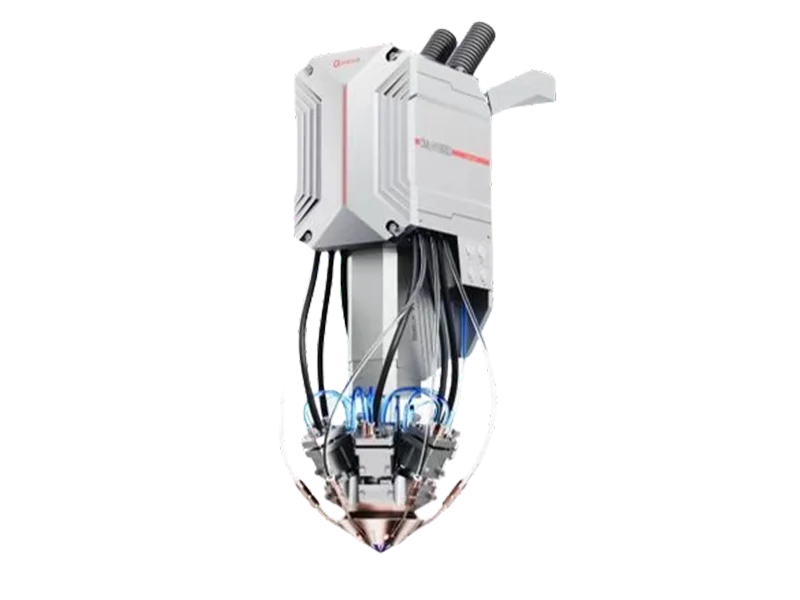
Core Directed Energy Deposition System Components Enabling Reliable Deposition
The energy source in a directed energy deposition system fundamentally governs thermal history and thus defect susceptibility. Laser systems offer high spatial precision and tight melt pool control, minimizing spatter and porosity when parameters are well tuned. However, rapid thermal cycling can induce residual stresses that promote cracking in susceptible alloys like nickel based superalloys or high strength steels. Electron beam systems operate under vacuum, eliminating oxidation and hydrogen pickup, which are key contributors to weld metal porosity, while delivering deeper penetration for robust fusion. That depth requires precise beam shaping to avoid keyhole instability and gas entrapment. Plasma arc systems, commonly used with wire feedstock, provide a broader heat affected zone and greater tolerance to surface contamination, but their higher heat input risks grain coarsening and distortion unless travel speed and power are tightly coordinated. Selecting the optimal energy source and integrating it with real time feedback is essential for consistent, defect free deposition.
Reliability hinges on how seamlessly the deposition head coordinates feedstock delivery with motion control. Wire fed heads paired with multi axis robotic arms or gantries deliver high deposition rates and near total material utilization, making them ideal for large structural components. Their continuous feed simplifies inert gas shielding, but success depends on precise synchronization between wire feed speed, torch oscillation, and traverse motion to prevent humping or inconsistent bead geometry. Powder fed heads inject metal powder coaxially or laterally into the laser melt pool, enabling finer resolution, graded compositions, and thinner layers, which are ideal for repairs and feature additions. Yet powder catch efficiency, nozzle alignment, and stand off distance demand rigorous calibration because even minor drift can cause unmelted particles or interlayer delamination. Advanced motion platforms now integrate real time process data such as melt pool dimensions or thermal signatures to dynamically synchronize head movement, ensuring uniform layer bonding and geometric fidelity regardless of feedstock type.
Thermal Management and Melt Pool Control for System Reliability
Real time optical monitoring forms the foundation of stable melt pool control in reliable directed energy deposition systems. Coaxial thermal imaging and high speed cameras capture melt pool size, temperature distribution, and solidification dynamics, feeding a continuous data stream for closed loop adjustment. As multi layer builds progress, heat accumulation naturally enlarges the melt pool, compromising dimensional consistency. Closed loop systems counteract this drift within milliseconds by modulating laser power or deposition speed. For example, an adaptive model predictive control algorithm incorporating a one dimensional thermal model successfully stabilized melt pool dynamics and maintained uniform layer height across a nickel based superalloy build. Similarly, a proportional controller using melt pool area as its primary indicator by adjusting both laser power and dwell time kept the melt pool within a user defined window for stainless steel, suppressing surface defects and ensuring cross sectional uniformity. By responding to live thermal signatures, these systems transform deposition from an open loop process into a self correcting manufacturing cell capable of repeatable quality across complex geometries and evolving thermal histories.
Cooling rate is the principal driver of final microstructure and therefore mechanical performance in deposited parts. Uncontrolled rapid solidification may produce brittle phases like martensite in steels or Laves phases in nickel superalloys, while overly slow cooling encourages grain coarsening and segregation. Spatially resolved cooling rate control enabled by dynamic adjustment of heat input has demonstrated measurable improvements in microstructural homogeneity. In a five layer wall experiment, closed loop regulation of the cooling rate at twelve hundred degrees Celsius yielded uniform hardness across all layers, confirming consistent grain structure throughout the deposit. Equally vital is the inert atmosphere surrounding the melt pool: continuous argon or nitrogen shielding prevents oxide formation, nitride embrittlement, and hydrogen induced porosity. Together, controlled cooling and rigorous atmospheric management ensure each deposited bead exhibits predictable grain morphology and mechanical integrity, whether on the first or fiftieth layer.
Process Control Parameters and Performance Metrics Defining Reliability
A system reliability is quantified by three core performance metrics: layer thickness accuracy, positional repeatability, and repair fidelity. A process capability index greater than 1.33 for layer thickness signals statistically stable deposition, widely recognized as a benchmark for industrial grade consistency. Positional repeatability, typically required within plus or minus fifty micrometers, ensures precise interlayer alignment, preventing voids, lack of fusion, or stair stepping artifacts. In repair applications, fidelity to original geometry is non negotiable because top tier systems restore critical components like turbine blades or injection molds to near net shape, drastically reducing post machining effort. These metrics collectively reflect the system ability to meet stringent dimensional tolerances and mechanical specifications, directly linking process control to functional part performance.
Adaptive parameter tuning enables intentional, real time control of grain morphology during deposition. By adjusting laser power and scan speed, operators influence local cooling rates: lower power increases cooling rate, promoting fine equiaxed grains, while higher power slows cooling, encouraging columnar or coarse grains. Closed loop systems that monitor melt pool temperature can automatically tune these parameters to target specific microstructures, such as fine equiaxed grains for enhanced fatigue resistance or epitaxial growth for directional strength. This capability transforms grain structure from a passive outcome into an actively engineered property, directly connecting process control to the long term functional reliability of safety critical components.
Standardization and Smart Monitoring in Reliability Assurance
Directed energy deposition systems often deliver inconsistent outputs due to fragmented process standards. A recent industry survey found that fifty five percent of unexpected downtime stemmed from non standardized parameters across machines and facilities. Smart monitoring technologies including real time melt pool analytics, acoustic emission sensing, and predictive maintenance algorithms offer a pragmatic path toward reliability assurance while formal standards mature. By embedding sensor driven feedback loops into the control architecture, operators enforce consistent thermal profiles, feedstock delivery, and motion coordination even without universal parameter definitions. This intelligent oversight shifts systems from manually tuned tools to self regulating production units, delivering repeatable part quality and sustained operational stability.
Frequently Asked Questions
-
What is directed energy deposition? Directed energy deposition is an additive manufacturing process where focused thermal energy, often from a laser or electron beam, melts material such as wire or powder to create or repair complex three dimensional components.
-
What energy sources are commonly used in these systems? Systems commonly use lasers, electron beams, or plasma arcs to provide the thermal energy required for material deposition and fusion.
-
Why is thermal management critical for system reliability? Thermal management ensures melt pool stability, uniform cooling rates, and consistent microstructures, preventing defects like residual stresses, porosity, or grain coarsening.
-
How do wire and powder feed systems differ in applications? Wire feed systems offer higher material utilization and deposition rates ideal for large components, while powder feed systems provide finer resolutions better suited for repairs and feature additions.
-
What role does real time monitoring play in the process? Real time monitoring captures thermal and geometric data to adjust parameters dynamically, ensuring consistent deposition quality and reducing defects.
-
What are some key performance metrics for evaluating system reliability? Core metrics include layer thickness accuracy, positional repeatability, and repair fidelity, which collectively ensure reliable and precise component manufacturing.