
 EN
EN
Process Optimization And Melt Pool Stability In Inconel 718 Deposition
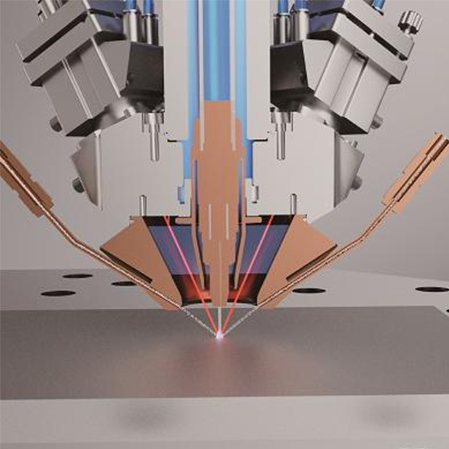
In directed energy deposition of Inconel 718, laser power, scan speed, and powder feed rate jointly govern melt pool stability and defect formation. High laser power combined with low scan speed increases melt pool size and penetration depth, but risks keyhole instability and spherical porosity due to excessive liquid metal flow. Conversely, insufficient power or excessive speed reduces energy input, leading to lack of fusion defects and irregular voids from incomplete powder melting. Powder feed rate modulates mass input and thermal load, where excessive rates can quench the melt pool and trap unmelted particles, while overly low rates compromise deposition efficiency. A stable, smooth, and consistent melt pool emerges only within a narrow process window. When optimized with balanced parameters that control heat input and layer height, porosity can be reduced significantly and liquation cracking suppressed. Real time coaxial melt pool imaging enables dynamic parameter adjustments to maintain this stability, underscoring the necessity of systematic calibration for high density components. Furthermore, volumetric energy density provides a useful empirical metric for linking thermal input to porosity reduction. In near net shape builds, volumetric energy density exhibits a non-linear relationship with relative density, where specific energy windows consistently achieve relative densities exceeding ninety nine percent as validated by X-ray microtomography. However, energy density alone remains insufficient, as interlayer remelting depends critically on vertical step increments and hatch spacing to ensure complete fusion.
Microstructural Control And Laves Phase Mitigation During Processing
Rapid cooling rates drive extreme non-equilibrium solidification in Inconel 718, yielding fine dendritic structures and pronounced microsegregation of niobium into interdendritic regions. This niobium enrichment locally favors the formation of the brittle Laves phase while depleting the matrix of solutes required for strengthening precipitates. As a result, as deposited material commonly contains a continuous, interconnected Laves network that impairs ductility and fatigue resistance, while strengthening phases remain minimal. Controlling this segregation driven phase evolution is therefore central to achieving wrought equivalent mechanical performance. Interpass thermal management serves as the most effective in process strategy for suppressing Laves phase formation. Limiting interpass temperatures and matching layer thickness to melt pool dimensions increases effective cooling rates, shortening the time available for niobium diffusion and disrupting continuous network development. Optimized heat input through adjusted laser power and scan speed further narrows the mushy zone and promotes a finer, more dispersed Laves morphology. Complementary approaches include controlled substrate preheating to moderate thermal gradients without exacerbating segregation, constraining solute partitioning and retaining more niobium in solid solution for subsequent precipitation hardening.
Advanced Post Deposition Heat Treatments For Superior Mechanical Performance
Standard AMS 5663 heat treatments involving conventional solution annealing followed by double ageing are frequently inadequate for directed energy deposition of Inconel 718, because rapid solidification traps Laves phases and preserves niobium segregation that resists dissolution at standard temperatures. Advanced post deposition protocols instead employ elevated solution temperatures for extended durations to fully dissolve Laves phases, homogenize solute distribution, reduce residual porosity, and recrystallize the dendritic microstructure. Recent metallurgical studies on additively manufactured Inconel 718 demonstrate that extended high temperature solution treatments followed by modified double ageing cycles increase yield strength substantially while maintaining high elongation values. This tailored schedule optimizes strengthening phase nucleation kinetics by boosting precipitate volume fractions and refining size distributions without over ageing. By precisely balancing the dissolution of as deposited defects with controlled precipitation hardening, these protocols enable components to meet or exceed rigorous wrought alloy performance standards.
Frequently Asked Questions
-
What are the main factors affecting melt pool stability? Main factors include laser power, scan speed, and powder feed rate, which jointly affect melt pool size, stability, and the risk of defects such as porosity or lack of fusion voids.
-
What is volumetric energy density and why is it important? Volumetric energy density is a metric linking thermal input to porosity reduction, and controlling it within specific ranges ensures optimal relative density in directed energy deposition builds.
-
How does processing affect the microstructure of Inconel 718? Rapid cooling rates drive non-equilibrium solidification, leading to niobium microsegregation that promotes brittle Laves phase formation and reduces key strengthening phases.
-
What strategies help suppress Laves phase formation during deposition? Interpass thermal management, optimized heat inputs, substrate preheating, and matching layer thickness to melt pool dimensions are effective strategies to suppress Laves phase development.
-
What heat treatments improve mechanical performance? Tailored heat treatments, including elevated solution temperatures and modified double ageing protocols, dissolve Laves phases and enhance mechanical strength and ductility beyond standard specifications.